






Table of Content
How to Choose Reliable Luggage for International Trips and Avoid Mishaps (2026 Guide)

Choosing reliable luggage is one of the most effective ways to prevent common travel disruptions before they happen. International travel places greater demands on luggage—longer transit times, more handling, and stricter airline regulations all increase the risk of delays, damage, or inconvenience. The right luggage does more than carry your belongings; it supports efficient movement, protects essential items, and performs consistently across repeated trips.
In 2026, reliable luggage is defined by four key factors: durable materials, high-quality hardware, compatibility with airline requirements, and long-term service support. Brands like LEVEL8 approach this through an engineering-first perspective—focusing on structural integrity, refined design, and consistent performance across real travel conditions. This guide outlines how to choose luggage that minimizes risk and creates a smoother, more predictable international travel experience.
Understand Airline Size and Weight Restrictions
Before selecting luggage, it is essential to understand airline requirements. While there are general standards, rules vary by airline, route, and ticket class.
Typical international guidelines include:
-
Carry-on size: Approximately 21–22 inches (including wheels and handles)
-
Carry-on weight: Commonly 7–10 kg (15–22 lbs), often strictly enforced
-
Checked baggage: Typically 23 kg (50 lbs) for economy class
However, these limits are not universal. Many international carriers—especially in Europe and Asia—enforce weight limits more strictly than U.S. domestic airlines.
To avoid issues:
-
Measure the full exterior dimensions of your luggage
-
Check your airline’s policy before both purchase and departure
-
Account for wheels and handles when measuring size
Failing to meet these requirements can result in unexpected fees or forced gate-checks, which can disrupt your travel flow.
Define Your Travel Profile and Terrain
Reliable luggage should match not only airline requirements but also the environments you travel through. The type of terrain you encounter plays a significant role in how your luggage performs.
-
Four-wheel spinners are best for smooth airport floors and hotel environments, allowing effortless movement
-
Two-wheel rollers perform better on uneven surfaces such as cobblestones or stairs
-
Hybrid or backpack setups are ideal for mixed environments where flexibility is required
Choosing the right mobility system ensures smoother transitions and reduces strain during longer travel days.
Prioritize Durable Materials and Construction
Material quality is one of the most important factors in determining long-term reliability. High-performance luggage is designed to withstand repeated handling while maintaining structure and protection.
-
Polycarbonate: Lightweight, flexible, and impact-resistant
-
Aluminum or aluminum-magnesium alloys: Rigid, durable, and structurally strong
-
Ballistic nylon: Durable and flexible for softside designs
Brands like LEVEL8 combine Makrolon polycarbonate and aerospace-grade aluminum frames to balance strength, weight, and refined aesthetics. This approach ensures that luggage maintains its performance across different travel conditions without unnecessary bulk.
LEVEL8 Carry-On for International Travel


LEVEL8 designs are built around durability, structure, and travel efficiency, making them well-suited for international use.
LEVEL8 Voyageur Carry-On
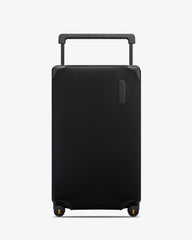
Designed for travelers who prioritize lightweight efficiency and smooth mobility, the Voyageur features a polycarbonate shell and wide-handle structure that creates a flatter interior packing space. This allows for more efficient organization while maintaining a streamlined profile.
LEVEL8 Gibraltar Aluminum Carry-On
Built for travelers who prioritize structural strength and long-term reliability, the Gibraltar uses an aluminum-magnesium shell and reinforced frame system. Its rigid construction provides enhanced protection during demanding travel conditions.
Together, these designs reflect a focus on engineering precision and refined usability, rather than unnecessary complexity.
Evaluate Wheels, Handles, and Hardware
The most common points of failure in luggage are the moving components. Wheels, handles, and closures experience the most stress and should be carefully evaluated.
What to Look For
-
Smooth, quiet spinner wheels with stable alignment
-
Telescopic handles with minimal wobble and strong lock points
-
Durable closures (zippers or frame systems)
-
Integrated TSA-approved locks
Quick Inspection Checklist
-
Roll the suitcase to test stability and noise
-
Extend and test handle rigidity
-
Check closure smoothness and alignment
-
Inspect corners and reinforcements
High-quality engineering—such as the precision wheel systems and reinforced structures used in LEVEL8 designs—helps ensure consistent performance across frequent travel.
Consider Warranty and Service Support
Reliable luggage is defined not only by initial performance, but also by long-term support. A strong warranty indicates confidence in the product’s construction.
Look for:
-
Coverage of key components (wheels, handles, shell, closures)
-
Clear repair or replacement policies
-
Accessible service support
LEVEL8 emphasizes long-term usability and structural reliability, offering support systems designed to maintain performance across repeated travel cycles.
Plan for Smart Packing and Maintenance
Even the best luggage performs better with proper use and care.
Smart Packing Practices
-
Use packing cubes to organize items
-
Keep essential items accessible
-
Avoid overpacking to reduce strain
-
Pack with intention to stay within limits
Maintenance Tips
-
Clean wheels regularly
-
Check handles and closures before trips
-
Store luggage properly
-
Use identifiable tags to prevent mix-ups
These habits help extend the lifespan of your luggage and maintain consistent performance.
How to Avoid Common Travel Mishaps
Many travel disruptions can be prevented by making informed decisions early.
To reduce risk:
-
Confirm airline requirements in advance
-
Choose luggage suited to your travel conditions
-
Prioritize durability and hardware quality
-
Maintain your luggage regularly
Reliable luggage plays a key role in ensuring a smoother, more predictable travel experience.
Final Thoughts
Reliable luggage is not about having more features—it is about consistent performance across real-world travel conditions. The best designs combine durable materials, precision engineering, and thoughtful organization to support how you move.
For international travel, where conditions are less predictable, this reliability becomes even more important. By focusing on materials, construction, mobility, and long-term support, you can choose luggage that integrates seamlessly into your journey.
Well-designed luggage—such as those built with an engineering-first approach—works quietly in the background, allowing you to travel efficiently, stay organized, and focus on the experience itself.


Leave a comment