



Table of Content
Business Travel Essentials: What You Actually Need for a Smooth Trip (2026 Guide)

Business travel often appears straightforward—pack a bag, catch a flight, attend meetings—but in practice, it can quickly become inefficient without the right setup. Delays at security, disorganized packing, and constant unpacking can all add unnecessary friction. The key to a smooth trip is not carrying more, but carrying what actually supports your workflow and movement.
In 2026, efficient business travel is built around three principles: clarity, separation, and accessibility. By organizing your essentials into clear categories and using the right combination of gear, you can move seamlessly between airports, hotels, and meetings without disruption. This guide outlines what you truly need for business travel, how to structure your setup, and why a simple system consistently outperforms complex packing strategies.
Who This Guide Is For
This approach is designed for professionals who need to stay efficient while traveling. It is especially useful for:
-
Frequent business travelers managing multiple trips per month
-
Professionals taking regular short trips (1–4 days)
-
Individuals balancing work responsibilities with travel logistics
For these travelers, time and consistency matter more than packing variety. A reliable system reduces decision-making and ensures that everything is exactly where it should be.
The Core Essentials
Most business trips require the same foundational categories of items. The difference lies in how they are organized and accessed.
1. Laptop and Work Tools
This is the most critical category for business travelers. It typically includes:
-
Laptop and/or tablet
-
Chargers and cables
-
Mouse, headphones, and accessories
-
Documents or notebooks
These items need to be protected, organized, and easily accessible, especially during airport security checks or in-transit work sessions.
2. Clothing for Meetings and Downtime
Clothing requirements depend on the nature of the trip, but most business travel involves:
-
Professional attire for meetings
-
Casual clothing for transit or downtime
-
Shoes and basic accessories
The goal is to pack versatile, wrinkle-resistant items that can be worn in multiple contexts without requiring excessive space.
3. Travel Documents and Essentials
These are the items you need to access frequently throughout your journey:
-
Passport or ID
-
Boarding passes and itineraries
-
Wallet and payment methods
-
Toiletries and personal essentials
Keeping these items easily accessible reduces delays and prevents unnecessary unpacking during transitions.
A Simple, Effective Setup
One of the most reliable ways to organize business travel is by using a two-part system:
-
A structured backpack for work essentials
-
A carry-on suitcase for clothing and bulk items
This approach creates clear separation between categories, making it easier to find what you need without disrupting the rest of your packing.
Why This System Works
-
Improved accessibility: Work items are always within reach
-
Better organization: Clothing and tech are separated logically
-
Faster transitions: Moving between airport, hotel, and meetings becomes more efficient
Instead of relying on a single bag to do everything, this setup allows each piece of luggage to serve a specific purpose.
LEVEL8 Setup for Business Travel
To illustrate how this system works in practice, here is a combination designed for efficiency and consistency.
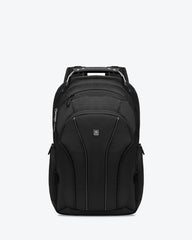
LEVEL8 Atlas Laptop Backpack
Use: Work essentials and daily carry


The Atlas Laptop Backpack is built around organization and device protection, making it ideal for carrying work-related items. It is designed to handle:
-
Laptop and tablet storage
-
Chargers and accessories
-
Travel documents and daily essentials
Its structured layout ensures that everything has a dedicated place, reducing clutter and making items easy to locate. This is especially useful during airport security checks or when working on the go.
Because of its slim, professional profile, the Atlas transitions easily between travel, office environments, and meetings, making it a versatile core piece for business travel.
LEVEL8 Voyageur Carry-On
Use: Clothing, shoes, and bulk items


The Voyageur Carry-On is designed for efficient packing and mobility, making it well-suited for short business trips. It is ideal for:
-
Clothing and shoes
-
Toiletries and travel accessories
-
Bulkier items that do not need frequent access
One of its key advantages is the wide handle design, which creates a flatter packing surface. This makes it easier to organize clothing and maximize space without increasing the suitcase size.
Combined with its lightweight build and smooth spinner wheels, the Voyageur supports fast, low-effort movement through airports and hotels.
Why This Combination Works
Separating your travel setup into two distinct components creates a more efficient and predictable system:
-
Backpack → Quick access and mobility
-
Carry-on → Structured packing and storage
This division reduces the need to constantly unpack and repack your belongings. For example:
-
At the airport: Keep your backpack with you for documents and devices
-
At the hotel: Leave your carry-on unpacked or partially unpacked without affecting your work setup
-
During meetings: Use the backpack as your primary work bag
This system aligns with how business travelers actually move—frequently transitioning between environments while needing consistent access to key items.
Additional Tips for Smoother Business Travel
To further optimize your setup, consider the following:
-
Pack with intention: Avoid unnecessary items and focus on essentials
-
Use versatile clothing: Choose pieces that work across multiple settings
-
Keep frequently used items accessible: Reduce the need to search or unpack
-
Maintain consistency: Use the same setup across trips to build routine
Over time, this consistency reduces decision fatigue and makes travel more predictable.
Final Thoughts
Business travel becomes significantly easier when your setup is simple, structured, and aligned with your routine. The goal is not to optimize every detail, but to create a system that works reliably across different trips.
When each item has a clear place and your gear supports how you move, you spend less time managing your luggage and more time focusing on your work. That efficiency—more than any individual feature—is what defines a successful business travel setup.

Leave a comment